

Will your SOPs hold up when your veterans retire?
When a veteran leaves the jobsite or plant floor, the crew inherits whatever SOPs exist. Why that knowledge stays unwritten, and how to build SOPs that work in the field.
A company can have SOPs on file but still miss what its people know. In a 2025 SHRM survey of U.S. HR professionals, three-quarters reported documenting their processes and procedures, yet the areas they left undocumented were the ones HR said would be hardest to rebuild if a veteran employee left. In about one in five of our discovery conversations, companies named knowledge trapped in employees' heads as a reason they came to us. One operations leader described the goal as getting it "out to paper into things that are repeatable and trainable."
In 2025, roughly 22 percent of people working in U.S. construction were 55 or older, according to the Bureau of Labor Statistics. Oil and gas calls its generational retirement wave the Great Crew Change. Succession in both industries involves more than filling roles, since experienced workers take their know-how with them.
Why experience is hard to document
Expertise is hard to put into words. The philosopher Michael Polanyi described this as knowing more than we can tell, and David Feldon's 2007 review of expertise studies explains why. Skills practiced for years become automatic, with background reasoning dropping out of conscious awareness. When veterans describe their methods from memory, they may leave out important steps they no longer notice.
An SOP written from memory can capture the standard path but rarely the reasons someone chooses one approach over another. Think of the operator who hears a bearing about to fail before any gauge moves, the estimator who prices around one client's change orders, or the superintendent who can tell from a three-week-old schedule which task will slip. Feldon's review points to structured elicitation, walking a veteran through real scenarios, as a way to recover much of what self-report leaves out.
What crews inherit instead
A paper mill we spoke with found its procedures were written in the office and weren't useful on the floor, and it planned to rebuild them by going directly to its operators. A 2026 study at a South African chemical-processing facility frames this as the gap between work as imagined and work as done. Workers there raised concerns about impractical procedures and limited frontline involvement in writing them, and the study's discussion emphasizes consulting the people doing the work and making instructions accessible where they're needed.
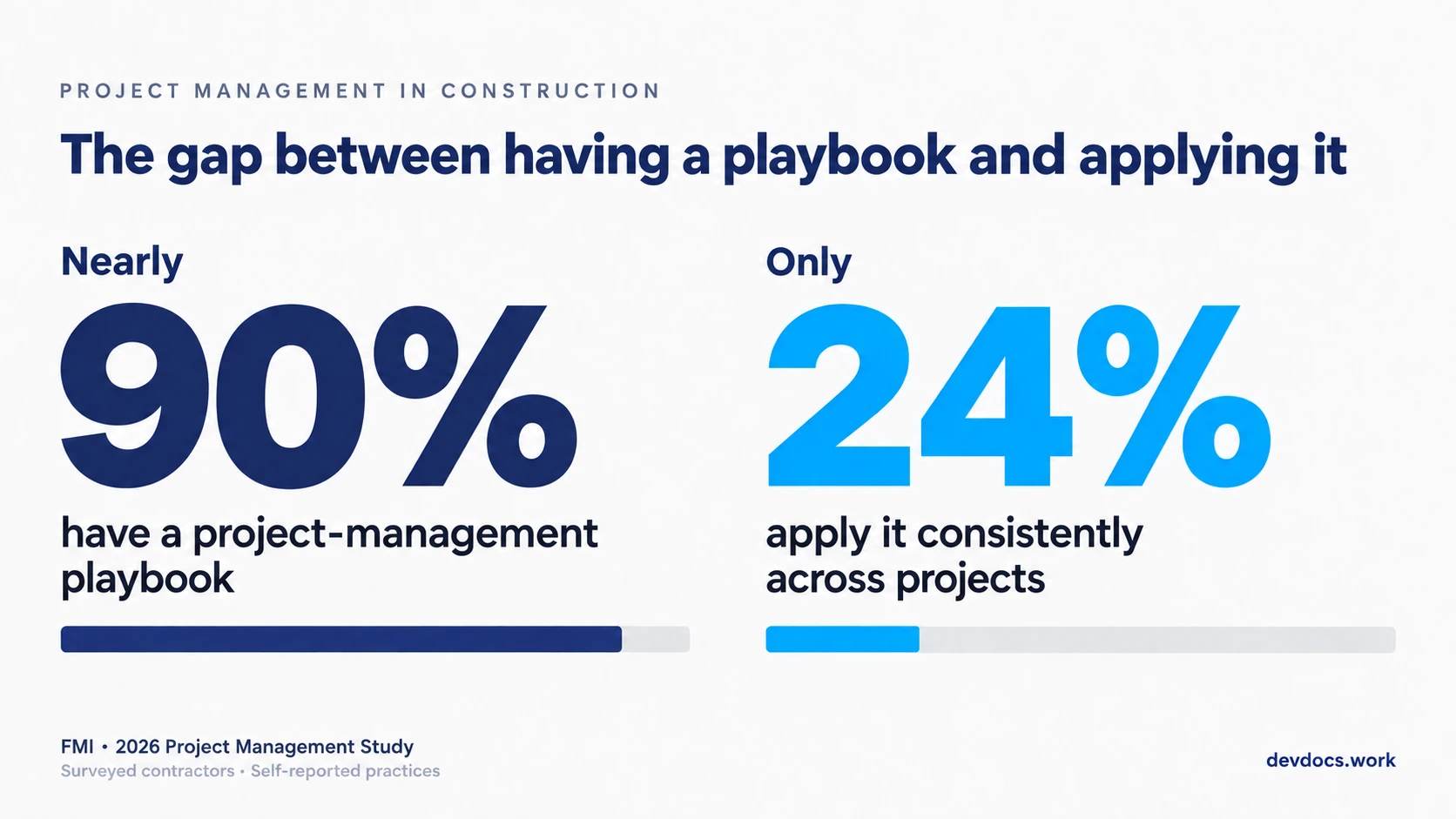
Construction shows the same gap on a larger scale. Nearly 90 percent of surveyed contractors in FMI's 2026 Project Management Study had a project-management playbook. Only 24 percent used it consistently. The playbook becomes the binder a new hire eventually learns to ignore.
Before a veteran retires, it's worth checking whether a new hire is learning the written procedure or the workaround their supervisor teaches them.
SOPs that work in the field
Writing everything down in a veteran's final two weeks leaves little time to check results. At DevDocs, we judge documentation by five qualities, whether it's accessible, accurate, actionable, audience-driven, and ultimately AI-ready, and field SOPs put the first four to the test.
When construction crews and subcontractors rotate between job sites, a shared format written for the crews who use it keeps them from relearning the layout on every job. SOPs kept on a tablet stay accessible when crews need them, and an SOP with a named owner stays accurate as methods change. In energy and process operations, if a pump or valve configuration gets swapped, an SOP written for the old setup can steer crews the wrong way, so each equipment or process change should trigger an update, with scheduled reviews as a backstop. Capturing the judgment behind each step is what makes an SOP actionable for someone who has never done the job.
Replacing experienced staff is its own challenge. The Department of Energy found that 76 percent of fuel-sector employers hiring in 2025, including oil and gas, had trouble filling roles. A shortage like that puts more weight on what new hires inherit, from the training they receive to the procedures they're handed.
The procedures a crew inherits are only as good as the experience behind them. When those four qualities hold, the same SOPs are ready for whatever tools come next, AI included. Talk to us about turning what your veterans know into SOPs your next crew can use.
Continue reading
Related posts from the studio.
 Compliance
Your 340B clients should have a CMS reporting plan
A covered entity's 340B claims can sit with several partners at once. What a TPA can take on, and what still needs an agreement with each client.
3 Min. Read
 Process Documentation
SOP documentation is necessary for SMB growth
When a business scales fast, undocumented processes become expensive problems. Learn why SOPs are the infrastructure that makes growth stick.
3 Min. Read
 Process Documentation
Your GDPR-compliant software doesn’t make you GDPR-compliant
Software may promise GDPR compliance, but that doesn't protect your business from potential litigation. Learn why technical GDPR experts are necessary for safeguarding against regulatory penalties.
3 Min. Read
Not ready to start yet?
Join the DevDocs Brief
Receive occasional notes from the studio: new articles, case studies, and documentation strategy updates.
See selected emailsReady to start?
Tell us about your documentation challenge.
We respond within one business day.